Why hasn’t stress ended—even when life looks successful?
Achievement was supposed to fix it. It didn't—and it can't. The root of unnecessary suffering isn't in your circumstances. It's in a mental process that takes less than one second.
This book shows you exactly where that process happens—and how to interrupt it.
Available on Amazon
Don't take our word for it. Read what clinical psychologists, scientists, and contemplative scholars say about this work. Read the Amazon preview too. If it resonates, get it.
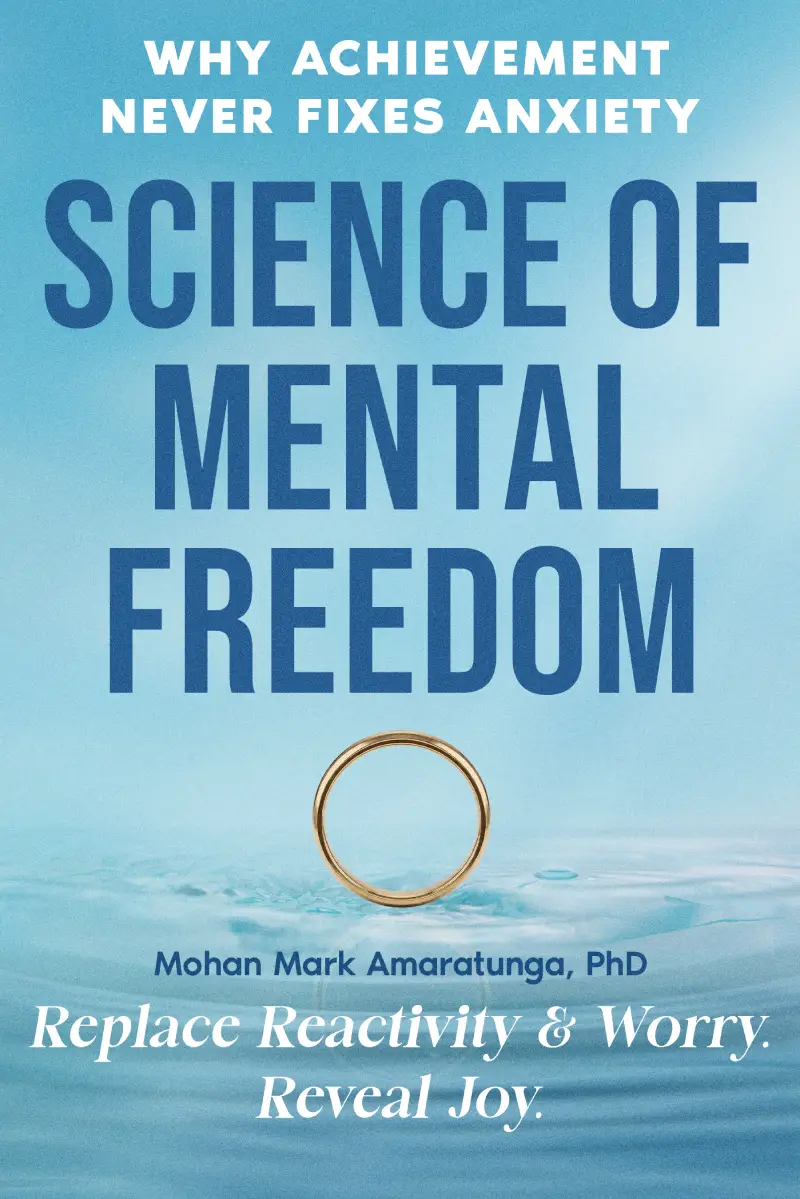
Why hasn’t stress ended—even when life looks successful?
Achievement was supposed to fix it. It didn't—and it can't. The root of unnecessary suffering isn't in your circumstances. It's in a mental process that takes less than one second.
This book shows you exactly where that process happens—and how to interrupt it.
Available on Amazon
Don't take our word for it. Read what clinical psychologists, scientists, and contemplative scholars say about this work. Read the Amazon preview too. If it resonates, get it.
What Scholars & Clinicians Say
What sets this book apart is how unmistakably it shows rather than preaches how the mind creates stress. The simple, yet elegant visuals make invisible mental processes suddenly obvious—once you see them, you can't unsee them. Grounded in the author's successful biotech career, it validates ancient wisdom through cutting-edge empirical neuroscience research.
Dipanjan Pan, PhD, FRSC, FAIMBE
Huck Chair Professor, Penn State
I’d encourage mental health clinicians and anyone with an interest in Mindfulness to read this. It is a behind-the-scenes look at the psychological and neurophysiological mechanisms involved in reducing mental suffering. Using examples drawn from daily life and simple thought experiments, Dr. Amaratunga illustrates subtle mechanisms in such a way that the reader naturally incorporates the teaching.
Dan Hetherington, PhD
Clinical Psychologist
Places particular emphasis on direct observation and personal verification rather than belief, closely aligning with the spirit of the Buddha's teachings. It presents inner transformation in a way that is accessible and approachable for all readers.
Rev. Soorakkulame Pemaratana, PhD
Chief Monk & CMU Lecturer
In high-pressure technology environments, stress often becomes accepted as part of the job. This book reads less like abstract philosophy and more like an operating manual for the mind, designed to sustain clarity and balance while performing at a high level. It offers a straightforward approach to building resilience without asking you to step away from ambition.
Don Gunaratne, PhD
Senior Engineer, Semiconductor Industry, Silicon Valley
An impressive attempt to show how our minds turn neutral events into suffering—and how to interrupt that process. A life journey distilled into clear, practical guidance for ending unnecessary mental distress.
Professor M Nirmalan, MD, PhD (Physiology)
University of Manchester
Forms a bridge between neurology, cognitive psychology, and Buddhism. This book can help the reader create a small space in the rapid and seemingly instantaneous mental processes to self-intervene for a more relaxed and effective style of living.
Craig R. Hartmann, PhD
Psychologist & Lifelong Buddhist Practitioner
A truly practical guide for the busy executive. The scientist in me loved the research and rationale, while the executive side appreciated how implementable each step was. Several a-ha moments kept me firmly engaged—specifically the section on Joy vs. Happiness and the stories our minds create. An insightful and highly recommended read!
Prameela Susarla
VP & Managing Director, Multinational Company, India
Everything on this website is freely available without email submission. This book exists to reduce unnecessary stress. Withholding insight behind forms would contradict its purpose.
This book does not ask readers to believe the author
It invites direct experiential verification, followed by confirmation through modern neuroscience and ancient contemplative wisdom. No belief is required.
The Achievement Paradox
You've checked the boxes. The degree. The career. The recognition. Maybe you help others for a living—patients, clients, colleagues who rely on your steady presence.
Yet at 3am, the mind still races. In quiet moments, something still feels unsettled. You've tried meditation apps, productivity systems, maybe therapy. They help, but the underlying current remains.
Here's what no one told you: the mind has no "enough" signal. Unlike your body, which knows when it's full, your mind will keep seeking indefinitely. External success cannot fix an internal process.
The good news? That process can be seen clearly. And what you can see, you can interrupt.
The Split Seconds Window
Where Freedom Lives
Twenty-five hundred years ago, contemplatives mapped the exact moment when the mind transforms ordinary experience into unnecessary suffering. They described a gap "as brief as the blink of an eye"—approximately 100-150 milliseconds.
Modern neuroscience has now confirmed this timing. Between stimulus and emotional reaction, there's a window of 150-200 milliseconds where the brain hasn't yet constructed its story.
This book teaches you to find that window—not through years of retreat, but through practical methods you can use during your actual life: in difficult meetings, tense conversations, sleepless nights.
The five steps

What You'll Learn
The Root Cause
Why achievement never fixes anxiety—and what actually drives the endless seeking.
Understand the difference between unavoidable pain (Type 1) and optional mental suffering (Type 2).
The Science
How ancient contemplative observations align precisely with modern neuroscience research on predictive processing, the Default Mode Network, and emotional construction.
The Practice
Three practical pillars for interrupting unnecessary suffering: Inquiry, Witnessing, and Letting Go. Methods that work during real challenges, not just on the meditation cushion.
The Shift
What changes when you see construction clearly: identity confusion dissolves, practice becomes self-verifying, and external dependency naturally fades.
For Those Who Hold Space for Others
If you work in healthcare (doctors, nurses), psychology, teaching, coaching, caregiving (including your own young children and aging relatives), or any helping profession, you understand the metabolic cost of sustained emotional labor. Research shows that empathy—feeling with others—depletes the same neural resources you need for yourself.
This book introduces a crucial distinction: empathy versus compassion. Compassion—caring for others without merging with their suffering—actually sustains rather than depletes. The ReSource Project at the Max Planck Institute found that compassion training reduces cortisol more effectively than mindfulness alone.
These aren't techniques that require you to retreat from your demanding life. They're methods that work precisely because you bring them into difficult moments—the code blue, the resistant patient, the impossible conversation.
AUTHOR
Mark Amaratunga, PhD
BRIEF BIO
Biochemist. Fifty-year student of direct mental inquiry. No formal lineage—just decades of investigation into how the mind constructs unnecessary suffering, verified against both ancient wisdom and modern science.
The Science of Mental Freedom
Bridging neuroscience and contemplative wisdom for the modern seeker.
NAVIGATE
CONNECT
Join the inquiry and receive monthly insights on the intersection of science and wisdom.
© 2026 Mohan Mark Amaratunga, PhD. All rights reserved.
© 2026 Mohan Mark Amaratunga, PhD.
All rights reserved.